
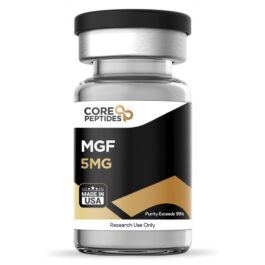
MGF (5mg)
$55.00$50.00
Mechano Growth Factor (MGF) is a naturally occurring peptide that is an isoform of the insulin-like growth factor (IGF-1) family. It's produced through the alternative splicing of IGF-1, particularly in response to mechanical stress, such as resistance training. MGF is being investigated for its potential to support muscle repair and growth, as well as its potential cardioprotective and neuroprotective properties.
Product Information
Specification | Details |
SKU | P-MGF-5 |
Purity | >99% |
Form | Lyophilized powder |
Size | 5mg |
Contents | MGF (5mg) |
Pricing
Quantity | Discount | Price (USD) |
Single Unit | N/A | $50.00 |
5 - 8 | 5% | $47.50 |
9+ | 10% | $45.00 |
Chemical Makeup
Specification | Details |
Molecular Formula | C_124H_204N_42O_41S_1 |
Molecular Weight | 2971.99 g/mol |
Other Known Titles | MGF-E, MGF-Ct24E |
Research and Clinical Studies
Muscle Mass & Recovery
Research suggests that MGF may have a role in muscle cell proliferation and hypertrophy. A study on muscle cell cultures found that the synthetic MGF-E domain appeared to increase muscle hypertrophy in older cells and prompted reserve cells to contribute to muscle formation, suggesting it may enhance muscle regeneration and maintenance (8).
Furthermore, in a study on mice with muscle contusion, MGF appeared to reduce the expression of inflammatory markers and oxidative stress, which may help mitigate inflammatory and fibrotic responses in injured muscles (9). This suggests the peptide may assist with the repair and healing of skeletal muscle injuries.
Tissue Repair
MGF is also being investigated for its potential to support the healing of skeletal injuries. In a study on rabbits with bone defects, the models exposed to MGF appeared to show improved bone healing compared to control groups (11). Research also hints that MGF may enhance the proliferation of osteoblast-like cells, and this effect may be more pronounced than with IGF-1.
Cardio- & Neuroprotective Potential
Studies have explored MGF's potential to protect cardiac and brain tissues. A study on cardiac cells undergoing apoptosis due to hypoxia suggested that MGF appeared to increase the migration of stem cells to the damaged tissue, potentially inhibiting cell death and acting as a protective compound (10).
Similarly, in a study on gerbil models of brain ischemia (stroke), MGF appeared to lead to increased protection of brain cells. Endogenous MGF production was also reportedly elevated in ischemia-resistant neurons, further supporting its potential neuroprotective role (12). Another study on mice that constitutively overproduced MGF in the hippocampus showed elevated levels of neurogenesis, suggesting MGF may have a role in brain cell proliferation and function (13).
Disclaimer: MGF peptide is available for research and laboratory purposes only.