
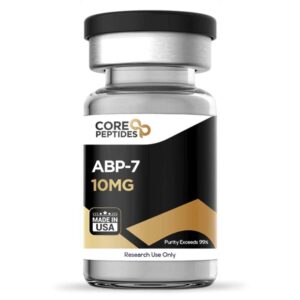
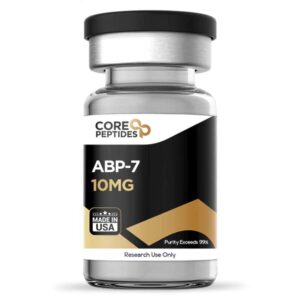
ABP-7 (10mg)
$62.00 $42.00
Size: 10mg
Contents: ABP-7
Form: Lyophilized powder
Purity: >99%
SKU: P-ABP-7
FREE Shipping on $200+ orders
ABP-7 Peptide: A Focus on Cellular Dynamics
What is ABP-7?
ABP-7 (actin binding peptide-7) is a synthetic heptapeptide composed of seven amino acids with the sequence Acetyl-LKKTETQ. This peptide is considered to be a fragment of a larger molecule, Thymosin Beta 4 (TB-500). As such, it is also known as a TB-500 Fragment. Produced via solid-phase peptide synthesis, ABP-7 is believed to act as the central actin-binding domain of its parent molecule, Thymosin Beta 4.
The core function of ABP-7 is thought to be actin binding, which involves inhibiting the polymerization of globular actin (G-actin) into filamentous actin (F-actin). This process is termed actin sequestration and may lead to an increase in free G-actin levels within the cell. Actin is a crucial component of the cellular cytoskeleton, providing structural integrity and playing a key role in cellular activities like motility and shape alteration. By stabilizing G-actin in its monomeric form, ABP-7 may limit the cell's ability to form the polymeric filaments necessary for a functional cytoskeleton. This alteration in cellular architecture could impact a cell's ability to migrate and adapt its shape, which are considered critical functions in various biological processes, including intracellular transport and signal transduction.
Key Areas of Scientific Research 🧪
1. ABP-7 and Wound Healing
Research has explored ABP-7's potential to promote wound repair in aged animal models. One study suggests that ABP-7 may encourage epidermal cell migration and increase collagen deposition within the wound site, facilitating wound closure and healing. Researchers commented that ABP-7's ability to promote repair in aged murine models was comparable to that of the parent molecule, Thymosin Beta 4. It is also posited that ABP-7's actions may be mediated by its interaction with purinergic receptors, which are thought to increase intracellular calcium levels. This rise in calcium is believed to activate cellular pathways that facilitate wound closure, such as cell migration and extracellular matrix remodeling. The peptide's influence on actin dynamics may also affect a cell’s ability to migrate and cover wound models, with the possibility that it enhances downstream signaling pathways that regulate cell proliferation and migration.
2. ABP-7 and Tissue Scarring (Fibrosis)
Research has been undertaken to investigate the anti-fibrotic properties of ABP-7 in the context of liver fibrosis. Preliminary data suggests that ABP-7 may influence the behavior of hepatic stellate cells (HSC) by potentially inhibiting the up-regulation of biomarkers like the PDGFβ receptor, α-smooth muscle actin (α-SMA), and collagen type I. The peptide appears to obstruct the phosphorylation of Akt, which may disrupt signaling pathways vital for cell proliferation and migration in fibrogenesis. This inhibition is conjectured to correlate with a reduction in the proliferation and migration of activated HSCs, suggesting a potential role in mitigating the fibrotic response.
3. ABP-7 and Angiogenesis
The peptide is also thought to have a role in promoting angiogenesis, the development of new blood vessels. It is believed that ABP-7 may facilitate endothelial cell behaviors crucial for new blood vessel formation, such as migration and tube formation. Ex vivo assays have suggested that ABP-7 possibly supports the initial steps of vessel sprouting, a key step in angiogenesis. By modifying actin's availability or organization, ABP-7 may influence the cellular architecture to favor angiogenic processes, which involve changes in cell shape and motility.
Product Specifications 📊
Molecular Formula: C_38H_81N_9O_20
Molecular Weight: 889.5 g/mol
Other Known Titles: TB-500 Fragment, Ac-LKKTETQ
Important Notice: ABP-7 peptide is available for research and laboratory purposes only.
Support
© 2025. All rights reserved.
WEIGHT LOSS