
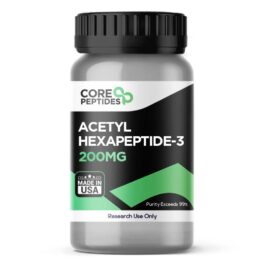
Acetyl Hexapeptide-3
$247.00$226.00
Acetyl Hexapeptide-3, also known as Acetyl Hexapeptide-8 or Argireline, is a synthetic peptide that's a fragment of a key protein in neuronal function. It is designed to act as a competitive inhibitor of SNAP-25 (synaptosome-associated protein 25 kDa), a component of the SNARE complex. This complex is essential for exocytosis, the process by which cells release molecules, including neurotransmitters like acetylcholine.
By potentially interfering with the formation of the SNARE complex, Acetyl Hexapeptide-3 may block the release of acetylcholine from nerve cells. Because acetylcholine is what signals muscles to contract, this inhibition may lead to a reduction in muscle contractions, which are a major cause of wrinkle formation. Unlike some bacterial toxins that are also used for this purpose, Acetyl Hexapeptide-3 is thought to act topically, making it a less invasive research option.
Chemical Makeup
Specification | Details |
Molecular Formula | C34H60N14O12S |
Molecular Weight | 888.99 g/mol |
Other Known Titles | Acetyl Hexapeptide-8, Argireline |
Export to Sheets
Research and Clinical Studies
Acetyl Hexapeptide-3 and Wrinkles
Acetyl Hexapeptide-3 has been studied for its potential to reduce wrinkles and fine lines. In one study with 10 subjects, an emulsion containing the peptide appeared to reduce wrinkle depth by 30% over 30 days. Another study on 24 subjects over 60 days suggested that the peptide not only had anti-wrinkle activity but also seemed to decrease transepidermal water loss (TEWL), indicating improved skin hydration.
Further research suggests that Acetyl Hexapeptide-3 may also influence collagen synthesis. A study on aged murine models showed that six weeks of peptide administration led to an increase in Type I collagen fibers and a decrease in Type III collagen fibers in the skin, a change that may be associated with the rejuvenation of aging skin.
Acetyl Hexapeptide-3 and Muscle Spasms
The peptide's ability to inhibit muscle contraction has led to its study in conditions like blepharospasm, which involves involuntary eyelid muscle contractions. A study involving 24 subjects with blepharospasm found a trend for a longer period of symptom control in the group receiving Acetyl Hexapeptide-3. The active group had an average of 3.7 months until the return of spasms, compared to 3.0 months in the placebo group, suggesting a possible therapeutic effect.
Acetyl Hexapeptide-3 and Scarring
A retrospective study suggests that Acetyl Hexapeptide-3 may help mitigate scar tissue by influencing collagen production. Scars are often characterized by an abundance of Type III collagen fibers, which are less elastic than the Type I fibers found in normal skin. By potentially decreasing the production of Type III collagen, the peptide may improve the elasticity of regenerating tissues. One study reported an increase in scar tissue elasticity from 33.5% to 40.5% in certain areas of the skin.
Acetyl Hexapeptide-3 and Pain Perception
A palmitoylated version of Acetyl Hexapeptide-3, called DD04107, has been researched for its potential analgesic properties. Studies suggest it may help block pain-related signaling by interfering with SNAP-25 activity, which is believed to prevent the release of neuromodulators essential for pain transmission. The peptide is also thought to inhibit the activation of TRPV1 channels, which are involved in transmitting pain signals, particularly those related to inflammatory processes. In models of chronic inflammatory pain, it has been observed to reduce both thermal and mechanical pain sensitivity.
Disclaimer: Acetyl Hexapeptide-3 peptide is for research and laboratory purposes only and is not intended for human or animal use.