
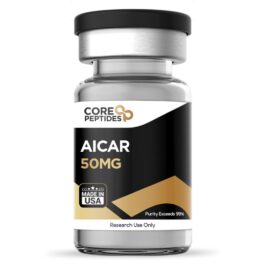
AICAR Peptide
$75.00$62.00
AICAR (5-aminoimidazole-4-carboxamide 1-β-D-ribofuranoside) is an analog of adenosine monophosphate (AMP), a key molecule in cellular energy metabolism. It is a research chemical that is thought to exert its potential by activating AMP-activated protein kinase (AMPK), a central enzyme in regulating energy balance. By activating AMPK, AICAR may improve glucose uptake, enhance insulin sensitivity, and mitigate metabolic disorders. It has also been studied for its potential in tissue protection, improving physical performance, and its effects on certain malignant cell lines.
Product Specifications
Specification | Details |
SKU | P-AICAR |
Purity | >99% |
Form | Lyophilized Powder |
Size | 50 mg |
Contents | AICAR |
Pricing
Free shipping on all orders over $200!
Quantity | Discount | Price (USD) |
5 - 8 | 5% | $58.90 |
9+ | 10% | $55.80 |
Chemical Makeup
Specification | Details |
Molecular Formula | C9H15N4O8P |
Molecular Weight | 338.21 g/mol |
Other Known Titles | AICA ribonucleotide |
Research and Clinical Studies
AICAR and Tissue Protection
Studies suggest that AICAR may offer protective benefits to various tissues, particularly against ischemia and reperfusion injury, which occurs when blood flow is restricted and then restored to an organ. A meta-analysis of five clinical studies suggested that AICAR could reduce myocardial infarction size and improve cardiac outcomes. Researchers hypothesize that this protective potential is linked to AICAR's ability to activate AMPK, which may alter cellular metabolism to be more resilient to oxygen deprivation. For example, by promoting myocardial glycogenolysis (the breakdown of glycogen), AICAR may increase the availability of glucose for energy production in low-oxygen conditions. Additionally, research on ethanol-induced hepatic steatosis (fatty liver) in murine models showed that AICAR appeared to reduce triglyceride synthesis.
AICAR and Insulin Sensitivity
By activating AMPK, AICAR is thought to increase glucose transport into cells, potentially improving insulin sensitivity. An experimental model on equine skeletal muscle showed that AICAR appeared to increase glucose uptake and improve insulin concentration. Another study suggested that both AICAR and physical activity may increase glucose uptake in muscle, but AICAR may also increase it in other tissues, potentially improving overall insulin sensitivity. Furthermore, AICAR may reduce the liver's glucose output and stimulate fatty acid oxidation.
AICAR and Endurance
Research suggests that AICAR may enhance physical endurance by promoting oxidative metabolism and mitochondrial biogenesis (the creation of new mitochondria). An experiment showed that AICAR appeared to induce metabolic genes and enhance running endurance in sedentary murine models by 44%. This effect is thought to be mediated by the AMPK-PPARδ pathway, which links energy status to the regulation of genes involved in energy metabolism. The activation of this pathway could lead to adaptations in muscle cells similar to those from endurance training.
AICAR and Malignant Cell Lines
Research on B-cell chronic lymphocytic leukemia (B-CLL) test models indicates that AICAR may trigger apoptosis (programmed cell death) in these cells. The process is thought to involve the activation of caspases and the release of cytochrome C. The studies suggest that AICAR's effects are dependent on its conversion to AICA ribotide (ZMP) inside the cells, which then activates AMPK.
Disclaimer: AICAR peptide is for research and laboratory purposes only and is not intended for human or animal use.