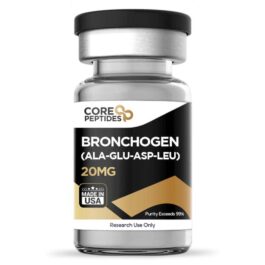
Bronchogen (20mg)
$98.00 $68.00
Bronchogen Product Information
Our Bronchogen is a high-purity, synthetic peptide available in a 20mg size. Provided in a lyophilized powder form with a certified purity of >99%, this product is intended for research purposes. The SKU is P-BRONCHOGEN-20.
Pricing and Discounts:
5-8 units: 5% discount, with a price of $64.60 per unit.
9+ units: 10% discount, with a price of $61.20 per unit.
We offer FREE shipping on all orders over $200.
Bronchogen Peptide: A Focus on Respiratory Health and DNA Regulation 🔬
What is Bronchogen?
Bronchogen (also known as AEDL) is a synthetic bioregulator peptide belonging to the Khavinson peptide family. Bioregulators are short signaling peptides that may cross cellular and nuclear membranes to interact directly with DNA. Bronchogen has been suggested by researchers to have a specific affinity for lung cells, where it may regulate the expression of genes such as NKX2-1, SCGB1A1, SCGB3A2, FOXA1, and FOXA2. Researchers also suggest that the peptide may preferentially bind with deoxyribooligonucleotides containing a CNG sequence, which are targets for DNA methylation and play a role in gene regulation.
Key Areas of Scientific Research 🧪
1. Bronchogen and DNA
Studies suggest that Bronchogen's potential actions on DNA may include reducing inflammation, promoting cellular differentiation, and preventing tissue remodeling. Its interaction with CNG sites, which are targets for DNA methylation, may influence gene expression and overall cell function. One study also found that Bronchogen appeared to increase the thermal stability of DNA, elevating its melting temperature by 3.1 °C. This suggests that the peptide may act as a DNA-stabilizing agent, possibly through non-covalent interactions with nitrogen bases. This finding hints at its potential utility in the study and stabilization of DNA structures.
2. Bronchogen and Cell Renewal
Bronchogen is posited to impact cell renewal processes and augment the functionality of bronchial epithelial cells. The peptide's specific binding to DNA, without visibly altering the double-helix structure, suggests a targeted interaction that could modulate cellular activities at the genetic level. Researchers have commented that the peptide may act as an "efficient agent stimulating the cell renewal processes and the enhancement of the functional activity of bronchial epithelial cells."
3. Bronchogen and Inflammation
Research has examined Bronchogen's potential impact on inflammation within the lungs. In murine models with damaged bronchial epithelium, the peptide appeared to lead to a reduction in neutrophilic inflammation and a normalization of pro-inflammatory cytokines. This suggests that Bronchogen may intervene in the inflammatory cascade, possibly by inhibiting pro-inflammatory cytokines and enzymes. Additionally, a structural and functional rejuvenation of the bronchial epithelium was observed, indicated by increased levels of secretory immunoglobulin A (IgA), a marker for local immunity.
4. Bronchogen and Tissue Remodeling
Trials have investigated Bronchogen's potential for preventing tissue remodeling in the lungs. In murine models exposed to nitrogen dioxide, the peptide appeared to abate typical symptoms of bronchial epithelium and lung tissue remodeling, such as goblet cell hyperplasia, lymphocytic infiltration, and emphysema. It also seemed to restore ciliated cells. These outcomes suggest that Bronchogen may not only alleviate physical restructuring and dysfunction of lung tissues but also potentially reverse these alterations. The enhanced production of secretory IgA and the modulation of inflammatory markers suggest a mechanism involving immune enhancement and inflammation control.
Product Specifications 📊
Molecular Formula: C18H30N4O9
Molecular Weight: 446.45 g/mol
Sequence: Ala-Glu-Asp-Leu
Other known titles: AEDL
Important Notice: These products are intended for laboratory research use only. It is not intended for human or veterinary use. All information provided is for educational and scientific reference only and has not been evaluated by the FDA or any medical regulatory body.
Support
© 2025. All rights reserved.
WEIGHT LOSS