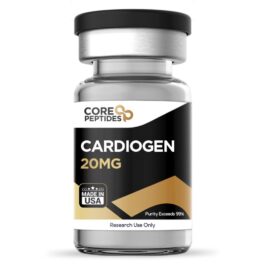
Cardiogen (20mg)
$55.00 $45.00
Cardiogen Product Information
Our Cardiogen is a high-purity, synthetic peptide available in a 20mg size. Provided as a lyophilized powder with a purity of >99%, it is intended for research purposes. The SKU is P-cardiogen.
Pricing and Discounts:
5-8 units: Get a 5% discount at $71.25 per unit.
9+ units: Enjoy a 10% discount at $67.50 per unit.
We also offer FREE shipping on all orders over $200.
Cardiogen Peptide: A Focus on Cardiac and Cellular Regulation 🔬
What is Cardiogen?
Cardiogen is a synthetic peptide bioregulator that is being researched for its potential to interact with the tissues of the cardiovascular system. It is also being studied for its potential to influence fibroblast activity, which plays a crucial role in scar formation and tissue repair. Researchers believe that Cardiogen may be able to enter different parts of cells, including the cytoplasm and nucleus, where it may influence gene expression and protein synthesis. The peptide has also been suggested to increase tumor cell apoptosis (programmed cell death).
Key Areas of Scientific Research 🧪
1. Cardiogen and Cancer Research
Cardiogen is being researched for its potential to increase tumor cell apoptosis. A study on murine models with M-1 sarcoma suggested that the peptide caused the development of hemorrhagic necrosis and stimulated tumor cell apoptosis. The supposed anti-proliferative action of the peptide appeared to be mediated by a specific mechanism related to the tumor's vascular network rather than a direct cytostatic effect. This indicates that Cardiogen may target the blood supply to the tumor, leading to cell death.
2. Cardiogen and Prostate Cell Aging
According to researchers, Cardiogen may significantly increase the expression of signaling factors involved in the differentiation of prostate fibroblasts, which typically decrease in aging cells. Because these factors are considered to decline in senescent (aging) fibroblasts, and Cardiogen appears to restore their levels, it is posited that the peptide may be a relevant candidate for further research into age-related dysfunctions of prostate cells.
3. Cardiogen and Cardiomyocytes Proliferation
A study on murine embryonic fibroblast cells suggested that Cardiogen may increase the levels of crucial proteins in the cytoplasm and nucleus, such as actin, vimentin, tubulin, and nuclear lamin A and C. These proteins are vital components of the cell's cytoskeleton and provide structural support to the nucleus. An increase in these proteins, which was about 2-5 times higher with Cardiogen than in a control group, suggests that the peptide may activate the expression of genes related to these proteins, potentially leading to increased cellular metabolism, growth, and differentiation.
4. Cardiogen and Cardiomyocytes Apoptosis
Research suggests that Cardiogen may be able to increase cardiomyocyte (heart muscle cell) proliferation while possibly decreasing fibroblast growth and scar formation, which could lead to improved cardiac remodeling. The peptide may achieve this by reducing the expression of the p53 gene, which is considered to be involved in initiating apoptosis. A study on murine models with myocardial damage showed that Cardiogen appeared to significantly reduce mortality and diminish necrotic zones within the myocardial tissue. It also seemed to help preserve glycogen content and protect mitochondria, suggesting that the peptide may assist in maintaining cell energy reserves and promoting reparative processes.
Product Specifications 📊
Molecular Formula: C18H31N7O9
Molecular Weight: 489.5 g/mol
Structure: H-Ala-Glu-Asp-Arg-OH
Other Known Titles: SCHEMBL3194515
Important Notice: Cardiogen peptide is available for research and laboratory purposes only. It is not intended for human or veterinary use. All information provided is for educational and scientific reference only and has not been evaluated by the FDA or any medical regulatory body.
Support
© 2025. All rights reserved.
WEIGHT LOSS