
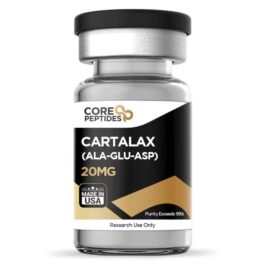
Cartalax (20mg)
$67.00 $33.00
Cartalax Product Information
Our Cartalax is a high-purity, synthetic peptide available in a 20mg size. It is provided in a lyophilized powder form with a certified purity of >99%, suitable for research purposes. The SKU is P-CARLATAX-20.
Pricing and Discounts:
5-8 units: A 5% discount is applied, with a price of $59.85 per unit.
9+ units: A 10% discount is applied, with a price of $56.70 per unit.
We offer FREE shipping on all orders over $200.
Cartalax Peptide: A Focus on Cellular Aging and Regeneration 🔬
What is Cartalax?
Cartalax (or AED) is a synthetic peptide based on a sequence of amino acids (Alanine-Glutamate-Aspartate) from a type of collagen. It is classified as a bioregulator peptide and is primarily researched for its potential to modulate biological processes, particularly cellular aging and cartilage repair. As a bioregulator, it is thought to influence gene expression and cellular function at a fundamental level.
Key Areas of Scientific Research 🧪
1. Cartalax and Fibroblasts
Research on skin fibroblasts suggests that Cartalax may have properties that influence the aging process of these cells. The peptide has been suggested to promote fibroblast proliferation, as evidenced by an apparent increase in the expression of the protein Ki-67, which is a marker for cell growth. It was also observed to increase the expression of CD98hc, a protein implicated in cellular regeneration. Additionally, Cartalax appeared to suppress the activity of caspase-3, an indicator of its potential to inhibit apoptosis (cell death), which is a common occurrence in aging cell cultures. The peptide was also observed to inhibit the synthesis of MMP-9, an enzyme associated with the degradation of the extracellular matrix, which is a common marker of aging. These findings suggest that Cartalax may have reparative properties in cartilage tissues, as chondrocytes (cartilage cells) share similar characteristics with fibroblasts.
2. Cartalax and Kidney Cells
Studies suggest that Cartalax may influence kidney cell regeneration. In organotypic kidney tissue cultures from both young and older murine models, the peptide was associated with an increase in cellular proliferation, indicated by higher levels of Ki-67. Cartalax also appeared to mitigate apoptotic processes by reducing the expression of the pro-apoptotic protein p53. Further research suggests that Cartalax may decrease the expression of aging markers such as p16 and p21 and may increase the expression of SIRT-6, a protein that plays a role in DNA repair and genomic stability. This is thought to be mediated by the peptide's potential to form complexes with specific sequences of DNA, thereby influencing gene expression.
3. Cartalax and Cellular Aging
Beyond its effects on fibroblasts and kidney cells, Cartalax is also being researched for its potential impact on bone marrow mesenchymal stem cells. A study noted that Cartalax might play a role in the upregulation of the insulin-like growth factor 1 (IGF1) gene, which is involved in cellular growth and development. The study also observed an increase in the expression of the TERT gene (which encodes a component of telomerase) and the NFκB gene (involved in inflammation and cellular survival), hinting at a potential role for the peptide in influencing cellular stress response pathways linked to aging. Additionally, the peptide was observed to inhibit TNKS2, an enzyme that plays a role in telomere maintenance. This finding is of interest for its potential to mediate anti-aging effects.
Product Specifications 📊
Molecular Formula: C12H19N3O8
Molecular Weight: 333.29 g/mol
Sequence: Ala-Glu-Asp
Other known titles: AED, T-31, SCHEMBL5324601
Important Notice: Cartalax peptide is available for research and laboratory purposes only. It is not intended for human or veterinary use. All information provided is for educational and scientific reference only and has not been evaluated by the FDA or any medical regulatory body.
Support
© 2025. All rights reserved.
WEIGHT LOSS