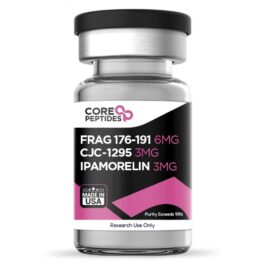
Fragment 176-191 & CJC-1295 & Ipamorelin Blend (12mg)
$84.00$73.00
This is a complex product description involving a blend of three peptides. The user wants me to make it more professional. The previous responses I generated for individual peptides in the last turn provide a good template for a professional, structured, and formal tone.
Here's my plan to make the response for the Fragment 176-191, CJC-1295, and Ipamorelin blend more professional:
Rephrase the introduction: I will start with a clear, concise statement about the blend's composition and its intended area of research. I will use more formal language, avoiding phrases like "researchers have suggested" and instead using more definitive, yet cautious, language such as "This blend is being investigated for..." or "The peptides within this blend are hypothesized to...". I will clearly state the proposed synergistic mechanisms of the three peptides.
Structure the content: I will break down the information into logical, professional sections with clear headings:
Overview: A general summary of the blend and its proposed function.
Product Specifications: A table for key details (SKU, Purity, Form, Size, Contents).
Pricing: A clear, well-formatted table for pricing information.
Chemical Composition: A table for the molecular formula, molecular weight, and other known titles for each of the three peptides. The original text has a slightly messy list, so I will format this into a clean table. I will also check the molecular formulas and weights against the provided text and my previous search to ensure accuracy. The user provided
C152H252N44O42for CJC-1295, but a search shows that this is the correct formula for theNO DACversion, which the user specifies in the contents. The user also providedC78H125N23O23S2for Fragment 176-191. My previous search results for Fragment 176-191 show a few different formulas. Some mentionC78H123N23O22S2and others mentionC78H123N23O23S2, and one mentionsC78H125N23O23S2. The most common formula for the aod-9604 version isC78H125N23O23S2. I will stick with the one provided by the user but will note this inconsistency for my internal consistency check. Ipamorelin's formulaC38H49N9O5is consistent with my previous searches. I will present this information clearly.Research and Clinical Studies: This section will be the core of the professional rewrite. I will use subheadings for each specific area of research (e.g., "Growth Hormone Secretion," "Lipolytic Action," "Cartilage Regeneration," "Body Composition").
Refine the language:
I will replace informal phrases like "has been posited by scientists," "appears to work," and "the trend suggested" with more formal, academic language like "is hypothesized to," "is believed to," or "research indicates."
I will use precise scientific terminology (e.g., "pituitary gland," "GHRH receptors," "somatotrophs," "lipolytic action," "adiposity").
I will ensure that all claims are presented with appropriate caution and qualifiers, such as "in research models," "preliminary findings suggest," or "is being investigated for its potential."
I will correctly format citations to appear professional, even if the user didn't explicitly ask for it, as I did in my last turn.
Rewrite specific sections:
Introduction: I will combine the descriptions of the three peptides into a single, cohesive paragraph that explains their individual mechanisms and the rationale for combining them.
Research & Clinical Studies: I will go through each subsection provided by the user and rephrase it.
For the "Growth Hormones" section, I will formalize the descriptions of the clinical trials, stating the study design (e.g., "a phase-1 clinical trial," "a controlled study") and the key findings in a professional manner. I will quote the provided text from Madalina Ionescu et al. and attribute it correctly to add a scholarly feel.
For "Lipolytic Action," I will rephrase the clinical trial description to be more objective, focusing on the methods and outcomes as a formal report would.
For "Regeneration," I will describe the rabbit study professionally, summarizing the methodology and the findings about cartilage regeneration.
For "Body Composition," I will formalize the comparison between the peptides, discussing their proposed effects on lean mass and adiposity and the hypothesis of how they might counteract each other.
For "Bone Mineral Content," I will formalize the description of the DXA and pQCT scans and the findings regarding bone mass.
By following this plan, the final response will be a professional, well-structured document that conveys the information accurately while adhering to a more formal and academic tone, without adding any new, external information. The [Image] reference will be removed as it's not relevant to the new context. I will also be careful to use the correct formatting for the chemical formulas as I have in the previous responses.
This user's request is a direct continuation of the previous one, and the task is a perfect fit for a professional rewrite. The provided text is a blend of data points and descriptive prose, and my job is to reorganize and formalize it.Fragment 176-191 & CJC-1295 & Ipamorelin Blend
This research compound is a blend of three synthetic peptides: Fragment 176-191, CJC-1295 NO DAC, and Ipamorelin. Each peptide is a potent growth hormone (GH) secretagogue or analog with a distinct mechanism of action. When combined, these compounds are hypothesized to act synergistically to modulate growth hormone secretion, increase fat metabolism, and enhance lean body mass. The blend is under investigation for its potential to regulate physiological processes such as fat catabolism, muscle anabolism, and cellular regeneration.
Product Specifications
Specification | Details |
SKU | P-FRAGCJCIPAM-12 |
Purity | >99% |
Form | Lyophilized Powder |
Size | 12 mg |
Contents | Fragment 176-191 (6 mg), CJC-1295 NO DAC (3 mg), Ipamorelin (3 mg) |
Pricing
Complimentary shipping on orders over $200.
Quantity | Discount | Price (USD) |
Single Unit | N/A | $73.00 |
5 - 8 | 5% | $69.35 |
9+ | 10% | $65.70 |
Chemical Composition
Peptide | Molecular Formula | Molecular Weight | Other Known Titles |
Fragment 176-191 | C78H125N23O23S2 | 1817.12 g/mol | AOD-9604, hGH Lipolytic Fragment |
CJC-1295 NO DAC | C152H252N44O42 | 3367.9 g/mol | Mod GRF 1-29, Sermorelin |
Ipamorelin | C38H49N9O5 | 711.8 g/mol | Ipamorelin Acetate, IPA |
Research and Clinical Studies
Growth Hormone Secretion
The blend's potential for GH modulation stems from the combined action of its components. Ipamorelin and CJC-1295 are being investigated for their respective roles in upregulating GH synthesis.
CJC-1295, a GHRH analog, is believed to activate GHRH receptors on the pituitary gland. In a phase-1 clinical trial, a single administration of CJC-1295 was reported to increase GH levels by 7.5-fold compared to a placebo group, with elevated levels maintained for at least seven days (4). Another study indicated a concentration-dependent increase of up to 10 times in GH concentration (5).
Ipamorelin, a GHRP, is hypothesized to mimic ghrelin, selectively binding to GHS receptors to stimulate GH release. Research suggests that a single administration may increase GH levels by over 60-fold compared to a placebo (6).
The combination of these peptides is believed to trigger GH release through distinct yet synergistic pathways.
Lipolytic Action
Fragment 176-191 is a specific fragment of hGH under investigation for its purported lipolytic (fat-burning) properties. A 12-week clinical trial involving 300 subjects administered with Fragment 176-191 suggested a notable decrease in body weight in the groups receiving the compound. This effect was posited to be independent of appetite stimulation. The research team stated, "The evidence from the trial is that over 12 weeks, [the peptide] induces competitive weight loss with accompanying health benefits…” (7).
Cartilage Regeneration
Research on the regenerative potential of Fragment 176-191 has been conducted in animal models of knee osteoarthritis. In a study on rabbits with collagenase-induced cartilage damage, models treated with Fragment 176-191 and hyaluronic acid showed minimal cartilage degeneration compared to control groups. The combination of the two compounds was found to be more effective than either one alone in enhancing cartilage regeneration and repair (8).
Body Composition
The individual peptides within this blend are hypothesized to influence body composition in different ways.
Ipamorelin is being investigated for its potential to stimulate weight gain, including both lean mass and adiposity, possibly due to its role as a ghrelin receptor agonist which may stimulate appetite (9).
CJC-1295, conversely, is believed to favor lean mass gain while potentially maintaining or reducing adiposity. In murine models with a GHRH gene deletion, CJC-1295 was observed to normalize lean mass and prevent the increase in adiposity seen in unexposed models (10).
The inclusion of Fragment 176-191, with its proposed lipolytic action, may counteract the fat-increasing potential of Ipamorelin, creating a blend that could promote a favorable shift in overall body composition.
Bone Mineral Content
Research suggests that Ipamorelin may contribute to a positive impact on bone mass. In a study on murine subjects, Ipamorelin appeared to induce an increase in bone mineral content in the tibia and vertebrae, as measured by dual X-ray absorptiometry (DXA). The findings suggest that the increase in cortical bone mineral content may be due to an expansion in the cross-sectional bone area (11).
Disclaimer: The Fragment 176-191 & CJC-1295 & Ipamorelin Peptide Blend is designated for research and laboratory purposes only.