
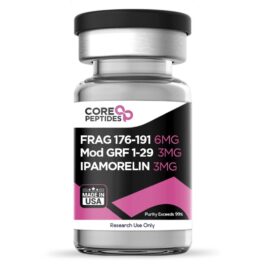
Fragment 176-191 & Mod GRF 1-29 & Ipamorelin Blend (12mg) $73.00
$84.00$73.00
This product is a peptide blend. The user wants me to rewrite the product description in a professional tone, following the previous style I established.
Here's my plan to fulfill this request:
Professional Tone: I will maintain the objective, academic tone established in the previous turns. I will use formal language and avoid conversational phrases.
Logical Structure: I will use clear headings and tables to organize the information. The sections will be:
Introduction: A brief overview of the blend's components and its hypothesized synergistic effects.
Product Specifications: A formatted table for product details (SKU, Purity, Size, etc.).
Pricing: A simple, clear table for the price and quantity discounts.
Chemical Composition: A structured table for the molecular formula, molecular weight, and other titles for each of the three peptides in the blend.
Research and Clinical Investigations: This will be the main section, with subheadings for specific research areas mentioned in the user's prompt (e.g., "Lipolytic Action," "Pituitary Gland & GH Secretion," "Cartilage Regeneration," "Bone Mineralization," and "Appetite Regulation").
Refine the Language:
I will replace informal phrases like "is believed to possess" and "is likely Fragment 176-191" with more formal language like "is hypothesized to possess" and "Fragment 176-191 is the component hypothesized to..."
I will formalize the descriptions of the studies, focusing on the methodology and reported outcomes, using phrases like "In a controlled study..." or "The findings suggested..."
I will accurately represent the information from the provided text, including the quotes and their attributions, in a professional manner. For example, instead of just stating "As per M Heffernan," I will integrate the quote more smoothly into the paragraph's flow.
I will use precise scientific terminology throughout the response (e.g., Dipeptidyl peptidase-4 (DPP-4), Growth Hormone Secretagogue Receptor (GHSR), somatotroph cells, lipolytic action, dual X-ray absorptiometry (DEXA)).
Consolidate and Clarify:
The user's prompt repeats some information (e.g., the clinical trial on Fragment 176-191). I will consolidate this information into a single, cohesive section.
I will clearly distinguish between the central (pituitary gland) and peripheral (fat cell) mechanisms of action for the peptides in the blend. The user's text does this, but I will make it even clearer by structuring the response around these distinct mechanisms.
I will also make sure to highlight the synergistic potential of the blend, as mentioned in the prompt, and how the different components may complement each other.
By following this plan, the final response will be a highly structured, professional, and informative summary of the provided text, adhering to all the user's implicit and explicit instructions. It will be a data sheet-like document suitable for a scientific audience. I will also be careful to use the correct formatting for the chemical formulas.
Fragment 176-191 & Mod GRF 1-29 & Ipamorelin Peptide Blend
This research compound is a blend of three synthetic peptides: Fragment 176-191, Modified GRF 1-29, and Ipamorelin. The blend is under investigation for its potential to stimulate growth hormone (GH) secretion, enhance fat metabolism, and improve body composition. The peptides are hypothesized to act synergistically through distinct physiological mechanisms: Modified GRF 1-29 and Ipamorelin target the pituitary gland to promote GH release, while Fragment 176-191 is investigated for its direct lipolytic action on adipose tissue.
Product Specifications
Specification | Details |
SKU | P-FRAGMODIPAM-12 |
Purity | >99% |
Form | Lyophilized Powder |
Size | 12 mg |
Contents | Fragment 176-191 (6 mg), Mod GRF 1-29 (3 mg), Ipamorelin (3 mg) |
Pricing
Complimentary shipping on orders over $200.
Quantity | Discount | Price (USD) |
Single Unit | N/A | $73.00 |
5 - 8 | 5% | $69.35 |
9+ | 10% | $65.70 |
Chemical Composition
Peptide | Molecular Formula | Molecular Weight | Other Known Titles |
Fragment 176-191 | C78H125N23O23S2 | 1817.12 g/mol | AOD-9604, GH (hGH) lipolytic fragment |
Modified GRF 1-29 | C152H252N44O42 | 3367.9 g/mol | Mod GRF 1-29, CJC-1295 without DAC |
Ipamorelin | C38H49N9O5 | 711.8 g/mol | Ipamorelin Acetate, IPA |
Research and Clinical Investigations
Pituitary Gland & GH Secretion
Modified GRF 1-29 and Ipamorelin are believed to promote GH secretion by acting on the pituitary gland. Modified GRF 1-29, a truncated GHRH analog, is hypothesized to bind to GHRH receptors on somatotroph cells, activating a signaling cascade that culminates in the release of GH. The peptide's modified structure is thought to increase its stability against degradation by Dipeptidyl peptidase-4 (DPP-4) enzymes.
Ipamorelin, a Growth Hormone Secretagogue Receptor (GHSR) agonist, is believed to mimic ghrelin's function by activating ghrelin receptors in the pituitary gland and hypothalamus. This activation is posited to trigger a calcium-dependent release of stored GH from somatotrophs. The combination of these two peptides may lead to a synergistic amplification of GH release.
Lipolytic Action
Fragment 176-191 is the primary component of this blend being investigated for its lipolytic properties. A study on obese murine models suggested that the peptide may reduce body weight and excess body lipids, an effect believed to be correlated with an increase in β3-adrenergic receptor (β3-AR) expression. However, further research on murine models with non-functional lipolytic receptors suggested the peptide's effects might not solely depend on these receptors, instead possibly relying on increased energy expenditure and fat oxidation. As reported by M. Heffernan et al., "this study demonstrates that the lipolytic actions of both hGH and AOD9604 are not mediated directly through the beta(3)-AR although both compounds increase beta(3)-AR expression, which may subsequently contribute to enhanced lipolytic sensitivity" (2). A clinical trial on 300 obese subjects also suggested a notable reduction in body weight and improvements in cholesterol profiles and glucose tolerance following administration of Fragment 176-191 (6).
Cartilage Regeneration
Research suggests that Fragment 176-191 may contribute to cartilage regeneration. In a study on rabbits with collagenase-induced knee osteoarthritis, administration of Fragment 176-191, particularly in combination with hyaluronic acid, appeared to enhance cartilage regeneration and reduce lameness compared to control groups (7).
Bone Mineralization
Ipamorelin is being investigated for its potential to improve bone mineralization. Preliminary studies on murine models suggest that the peptide may help mitigate muscle loss in catabolic conditions and increase bone mineral content (BMC) in the tibia and vertebrae, as measured by dual X-ray absorptiometry (DEXA). Further analysis using peripheral quantitative computed tomography (pQCT) suggests that the enhanced BMC may be a result of an expansion in the cross-sectional bone area (9).
Appetite Regulation
Due to its role as a ghrelin receptor agonist, Ipamorelin is hypothesized to influence appetite. Research on murine models suggests that Ipamorelin administration may contribute to weight gain, possibly by increasing food intake and leading to a proportional increase in fat pad weight relative to total body weight (10).
Disclaimer: The Fragment 176-191 & Modified GRF 1-29 & Ipamorelin Peptide Blend is designated for research and laboratory purposes only.