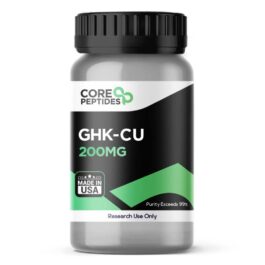
GHK-Cu (200mg)
$209.00$197.00
GHK-Cu is a naturally occurring complex molecule consisting of a GHK tripeptide (glycyl-histidyl-lysine) bound to a copper ion. The copper ion is believed to stabilize the peptide and facilitate its delivery to cells. Research suggests that GHK-Cu may play a crucial role in restoring damaged tissues and wound repair. It's also being investigated for its potential to stimulate the production of collagen, elastin, and glycosaminoglycans while exhibiting antioxidant and anti-inflammatory properties.
Product Specifications
Specification | Details |
SKU | P-GHK-CU |
Purity | >99% |
Form | Lyophilized Powder |
Size | 200 mg |
Contents | GHK-Cu |
Pricing
Quantity | Discount | Price (USD) |
Single Unit | N/A | $197.00 |
5 - 8 | 5% | $187.15 |
9+ | 10% | $177.30 |
Free shipping on orders over $200.
Chemical Makeup
Specification | Details |
Molecular Formula | C_14H_23CuN_6O_4 |
Molecular Weight | 340.38 g/mol |
Other Known Titles | Cu-GHK, Copper Tripeptide-1, 6BJQ43T1I9 |
Research and Clinical Investigations
Collagen Synthesis
Studies suggest that GHK-Cu may stimulate collagen synthesis and promote tissue recovery. Researchers hypothesize that the tripeptide sequence (Gly-His-Lys) may be released during the natural breakdown of collagen. This fragment is believed to then act as a cellular signal to fibroblasts, specialized cells that are essential for producing new collagen fibers. This process is posited to initiate tissue repair and regeneration.
In one study, GHK-Cu appeared to improve various indicators of photodamaged skin, including increased skin thickness, elasticity, and hydration (2). Further research on GHK-Cu's interaction with hyaluronic acid (HA) in an ex-vivo skin model suggested a synergistic action that significantly boosted the synthesis of collagen IV, a key component of the dermal-epidermal junction. This synergy was most pronounced at specific GHK-Cu to HA ratios, highlighting the importance of formulation in maximizing its effects (3).
Wound Healing & Infection
GHK-Cu is being investigated for its potential to accelerate wound healing and reduce the risk of infection. A clinical study on models with diabetic neuropathic ulcers reported a significantly lower infection rate (7%) in the GHK-Cu group compared to the control group (34%). The study also noted that the rate of wound closure was enhanced, particularly in larger ulcers (5).
Animal studies support these findings. In research on ischemic open wounds in rats, GHK-Cu appeared to reduce concentrations of inflammatory markers such as TNF-α, MMP-2, and MMP-9 (4). Another study on rabbits reported that GHK-Cu administration, especially in combination with high-intensity laser exposure, led to faster healing times, increased neutrophil and vessel counts, and accelerated the formation of granulation tissue—the new connective tissue and blood vessels that form during wound recovery (6).
Antioxidant Action
GHK-Cu is hypothesized to have antioxidant properties that may protect tissues from damage caused by active radicals. Studies suggest the peptide may have anti-radical potential against byproducts of lipid peroxidation and may prevent protein glycation (8). Additionally, GHK-Cu may reduce iron release from ferritin, which acts as a catalyst for lipid peroxidation, thereby potentially curbing inflammation in damaged tissues (9).
An animal study on lipopolysaccharide-induced lung inflammation in mice suggested that GHK-Cu may reduce the production of reactive oxygen species and inflammatory cytokines. It is thought to suppress the activation of key signaling pathways associated with inflammation, potentially leading to lower levels of inflammatory cells and molecules like TNF-1 and IL-6 (10).
Wrinkles & Skin Health
GHK-Cu has been suggested to have potential in improving the appearance of wrinkles and fine lines. A study on skin cell models with photodamage reported that the peptide appeared to reduce the depth of wrinkles while increasing skin density and thickness after 12 weeks (13). Other research has also associated GHK-Cu with improved skin attributes such as firmness, laxity, and clarity, as well as a reduction in coarse wrinkles and mottled pigmentation (14, 15).
Disclaimer: GHK-Cu peptide is designated for research and laboratory purposes only.