
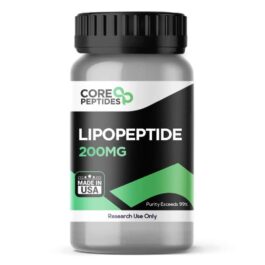
Lipopeptide (200mg)
$226.00$214.00
Lipopeptide (Palmitoyl-Gly-Gln-Pro-Arg) is a synthetic fragment derived from immunoglobulin G (IgG) that has been palmitoylated to enhance its penetration into skin tissue. It's being investigated for its potential to support the extracellular dermal matrix, reduce inflammation, and improve the appearance of photoaged skin cells.
Product Information
Specification | Details |
SKU | P-LIPOPEPTIDE-200 |
Purity | >99% |
Form | Lyophilized powder |
Size | 200 mg |
Contents | GHK-Cu |
Pricing
Quantity | Discount | Price (USD) |
Single Unit | N/A | $214.00 |
5 - 8 | 5% | $203.30 |
9+ | 10% | $192.60 |
Chemical Makeup
Specification | Details |
Molecular Formula | C_38H_68N_6O_8 |
Molecular Weight | 736.9 g/mol |
Sequence | Pal-Gly-Gln-Pro-Arg |
Other Known Titles | Pal-GQPR, Palmitoyl Tetrapeptide-7/3 |
Research and Clinical Studies
Extracellular Dermal Matrix
Research on Lipopeptide suggests it may have a role in improving skin structure and integrity. In a study using a blend of peptides including Pal-GQPR, echography tests suggested that the blend might reduce the thickness and support the density of the subepidermal layer, possibly enhancing the extracellular dermal matrix.
The peptide is also thought to potentially decrease the secretion of interleukin-6 (IL-6), a key cytokine in inflammatory responses, which suggests it may help mitigate inflammation, particularly that caused by UVB radiation (2). Additionally, it's hypothesized to stimulate the production of essential structural components of the skin, such as laminin IV and V, and collagen VII, which are crucial for skin repair and stability (2, 3).
Photoaged Skin Cells
A randomized controlled trial (RCT) investigated Lipopeptide's potential to improve the appearance of photoaged skin. In the study, the peptide appeared to stimulate the deposition of fibrillin-1, a marker for skin repair, which was comparable to the results seen with all-trans retinoic acid (RA) (4).
In a 6-month RCT, the peptide appeared to improve skin wrinkles compared to the baseline, and this effect became more pronounced after 12 months. Skin biopsies showed a significant increase in fibrillin-1 in the papillary dermis, supporting the idea that long-term use of Lipopeptide may lead to a visible improvement in photoaged skin (4).
Disclaimer: Lipopeptide is available for research and laboratory purposes only.