
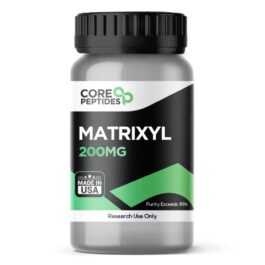
Matrixyl (200mg)
$184.00$171.00
Matrixyl, also known as palmitoyl pentapeptide-4, is a synthetic matrikine (a type of messenger peptide) being researched for its potential to stimulate collagen production in the skin. The palmitoyl conjugation is believed to enhance its stability and delivery across the skin. By acting as a signal peptide, Matrixyl is thought to interact with receptors on fibroblasts to regulate the synthesis of new collagen and other proteins crucial for the structural integrity of the skin's extracellular matrix (ECM).
Product Information
Specification | Details |
SKU | P-Matrixyl |
Purity | >99% |
Form | Lyophilized powder |
Size | 200mg |
Contents | Matrixyl |
Pricing
Quantity | Discount | Price (USD) |
Single Unit | N/A | $171.00 |
5 - 8 | 5% | $162.45 |
9+ | 10% | $153.90 |
Chemical Makeup
Specification | Details |
Molecular Formula | C_39H_75N_7O_10 |
Molecular Weight | 802.05 g/mol |
Other Known Titles | Palmitoyl pentapeptide-4, Palmitoyl pentapeptide-3 (prior to 2006) |
Research and Clinical Studies
Collagen Synthesis & Wrinkles
Studies suggest that Matrixyl may act as a signal fragment of type I collagen, potentially stimulating fibroblasts to synthesize new collagen and ECM proteins. Research indicates this effect may be concentration-dependent and related to the peptide's self-assembly properties (3).
Several studies have investigated Matrixyl's potential to improve skin texture and reduce wrinkles. In one study, the peptide reportedly reduced overall wrinkle depth compared to a placebo (5). Another study found that a compound infused with Matrixyl appeared to improve the appearance of the periorbital area after eight weeks (6). Additionally, a double-blind, randomized study reported that after four weeks, Matrixyl appeared to reduce skin texture and the depth of larger wrinkles in the periorbital region (7).
Scarring & Tissue Repair
Matrixyl is also being researched for its potential role in managing scar formation. A study reported that the peptide appeared to reduce the expression of α-SMA (alpha-smooth muscle actin) and inhibit the trans-differentiation of fibroblasts into myofibroblasts, cells that play a key role in the deposition of excess collagen during fibrotic scarring (8).
An animal study on wound healing suggested that Matrixyl may positively impact the healing process. In the study, wound healing was reportedly improved by up to 81.81% in the high-concentration Matrixyl groups compared to the negative control (9). The development of a novel conjugate of Matrixyl with imidazolium-based ionic liquid also showed comparable collagenesis-inducing activity, suggesting potential for enhanced delivery and properties (10).
Disclaimer: Matrixyl peptide is available for research and laboratory purposes only.