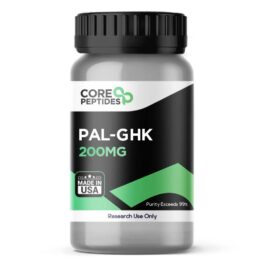
Pal-GHK (200mg)
$184.00$176.00
Pal-GHK, also known as palmitoyl-tripeptide-1, is a synthetic peptide that consists of the naturally occurring tripeptide GHK (Gly-His-Lys) attached to a palmitic acid molecule. The addition of the palmitoyl group is thought to enhance the peptide's ability to penetrate the skin. Pal-GHK is being investigated for its potential to stimulate collagen production, reduce the appearance of wrinkles, and exhibit antioxidant properties.
Product Information
Specification | Details |
SKU | P-PAL-GHK |
Purity | >99% |
Form | Lyophilized powder |
Size | 200mg |
Contents | Pal-GHK |
Pricing
Quantity | Discount | Price (USD) |
Single Unit | N/A | $176.00 |
5 - 8 | 5% | $167.20 |
9+ | 10% | $158.40 |
Chemical Makeup
Specification | Details |
Molecular Formula | C_30H_54N_6O_5 |
Molecular Weight | 578.8 g/mol |
Other Known Titles | Palmitoyl Tripeptide-1, Biopeptide-CL |
Research and Clinical Studies
Collagen Synthesis & Wrinkle Reduction
The GHK sequence is a fragment of the protein collagen that is naturally released during its breakdown. This fragment is believed to act as a signal to fibroblasts (the cells that produce collagen) to initiate the synthesis of new collagen and other components of the skin's extracellular matrix.
A clinical study on subjects who received Pal-GHK reported a statistically significant increase in skin thickness (5). Additionally, other clinical experiments using the peptide in a cream form have reported an apparent reduction in the length and depth of wrinkles (6, 7).
Antioxidant & Anti-inflammatory Potential
Research suggests that Pal-GHK's amino acid sequence may have potent antioxidative properties, potentially more powerful than other common antioxidants. It may neutralize free radicals and inhibit lipid peroxidation, which helps to protect cell membranes and reduce cellular damage (8, 10).
The peptide is also being investigated for its potential anti-inflammatory properties. Studies suggest that it may suppress the activation of the NF-κB and p38 MAPK signaling pathways, both of which are associated with inflammation. This action may reduce the infiltration of inflammatory cells and lower the levels of inflammatory cytokines (11). In one study, the GHK sequence was suggested to increase Nrf2 expression, a protein that regulates the expression of antioxidant proteins, in cell cultures exposed to oxidative stress from smoke inhalation (12).
Disclaimer: Pal-GHK peptide is available for research and laboratory purposes only.