
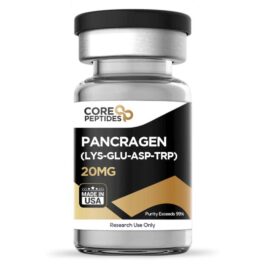
Pancragen (20mg)
$71.00$63.00
Pancragen is a synthetic tetrapeptide (Lys-Glu-Asp-Trp) that is being researched as a potential bioregulator for the pancreas. It is thought to influence gene expression associated with the differentiation and function of pancreatic cells. The peptide is being investigated for its potential to improve pancreatic health, address aging-related metabolic problems, and normalize aging biomarkers.
Product Information
Specification | Details |
SKU | P-PANCRAGEN-20 |
Purity | >99% |
Form | Lyophilized powder |
Size | 20mg |
Contents | Pancragen |
Pricing
Quantity | Discount | Price (USD) |
Single Unit | N/A | $63.00 |
5 - 8 | 5% | $59.85 |
9+ | 10% | $56.70 |
Chemical Makeup
Specification | Details |
Molecular Formula | C_26H_36N_6O_9 |
Molecular Weight | 576.25 g/mol |
Sequence | Lys-Glu-Asp-Trp (KEDW) |
Other Known Titles | DWa (amidate) |
Research and Clinical Studies
Pancreatic Function
Research suggests that Pancragen may be able to penetrate cellular membranes to influence gene transcription crucial for pancreatic cell differentiation. It is posited to up-regulate the expression of key differentiation factors like Ptf1a and Pdx1, which may play a role in the maturation of both acinar and islet cells in the pancreatic gland (1).
A study on murine models with induced metabolic problems showed that Pancragen appeared to bolster insulin production from beta (B) cells while tempering glucagon production from alpha (A) cells. It also seemed to normalize the proliferative activity and apoptosis of certain cells, suggesting a potential to restore pancreatic cell functionality (2).
Metabolic Problems & Aging
Pancragen is being investigated for its potential to address age-related metabolic dysfunctions. A study on aged subjects reported that Pancragen appeared to significantly lower fasting glucose levels and reduce insulin resistance, with its glucose-lowering action persisting after the study period (4).
The peptide may also influence key aging biomarkers. In a study on mature murine models, Pancragen exposure appeared to lead to a significant reduction of TNF-α levels and an elevation in IGF-I, both of which are critical indicators related to aging and metabolic processes. The study also suggested that Pancragen may have antiapoptotic potential, suppressing certain apoptotic components in pancreatic cells (7).
Pancragen is also thought to affect the methylation patterns of genes like PDX1, PAX6, and NGN3, which are linked to aging. This suggests that the peptide's influence may extend to the regulation of gene expression on a molecular level (8).
Disclaimer: Pancragen peptide is available for research and laboratory purposes only.