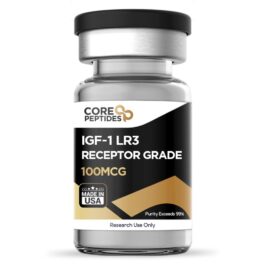
Receptor Grade IGF-1 LR3 (100mcg)
$34.00$28.00
Receptor Grade IGF-1 LR3 is a synthetic, long-acting variant of the naturally occurring insulin-like growth factor-1 (IGF-1). It has an extended N-terminal and a modified amino acid at residue 3, which is hypothesized to increase its anabolic potential and reduce its binding to IGF-1 binding proteins (IGF-1BPs). Receptor grade refers to its high purity.
Product Information
Specification | Details |
SKU | P-IGF1LR3-100 |
Purity | >99% |
Form | Lyophilized powder |
Size | 100mcg |
Contents | Receptor Grade IGF-1 LR3 (100mcg) |
Pricing
Quantity | Discount | Price (USD) |
Single Unit | N/A | $28.00 |
5 - 8 | 5% | $26.60 |
9+ | 10% | $25.20 |
Chemical Makeup
Specification | Details |
Molecular Formula | C_400H_625N_111O_115S_9 |
Molecular Weight | 9117.5 g/mol |
Other Known Titles | Long-(arg3) insulin-like growth factor-I |
Research and Clinical Studies
Anabolic Potential & Muscle Cells
Research on IGF-1 LR3's anabolic potential is limited, but a few studies on murine models suggest it may be 1.5 to 2 times more anabolic than IGF-I in inducing weight gain. One study on models exposed to dexamethasone reported that IGF-1 LR3 appeared to reduce Nτ-methylhistidine, a marker of muscle protein breakdown, to a greater extent than IGF-I (1).
Another study on female murine models suggested that IGF-1 LR3 appeared to potentially reverse the adverse effects of myostatin, a protein considered to prevent cellular differentiation. Mitigating myostatin's actions may increase lean muscle and reduce fat cell storage (7).
Insulin Receptor Sensitivity
Studies suggest that while IGF proteins typically bind to IGF-1 receptors to stimulate glucose uptake, Receptor Grade IGF-1 LR3 may also induce glucose uptake through other pathways or receptors. This indicates that it may enhance insulin sensitivity and improve glucose metabolism (5).
Cell Lifespan & Distribution
Preliminary research suggests that IGF-1 LR3 may indirectly help to increase the lifespan of functional cells by mitigating common markers of physiological decline, such as muscle tears and neurological deficiencies. Researchers note that the roles of growth hormones and IGF-1 are complex and may be an opportunity to explore their effects on specific stages of life (6).
An experimental study on mice reported that IGF-1 LR3 appeared to clear from the serum faster than endogenous IGF-1, as it appeared to bind less to binding proteins. This reduced binding affinity means it may circulate more freely. The study also noted that IGF-1 LR3 seemed to distribute more distinctly in tissues, with elevated levels observed in organs such as the kidneys, ovaries, and adrenal glands (8).
Disclaimer: Receptor Grade IGF-1 LR3 peptide is available for research and laboratory purposes only.