
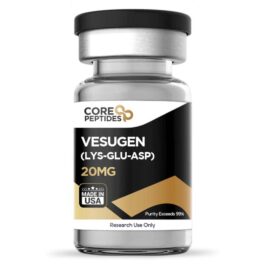
Vesugen (20mg)
$72.00$63.00
Vesugen, also known as KED, is a synthetic tripeptide from the Khavinson group of bioregulator peptides. It is derived from a sequence of amino acids found in vascular wall proteins and is being researched for its potential vasoprotective, neuroprotective, and geroprotective effects.
Product Information
Specification | Details |
SKU | P-VESUGEN-20 |
Purity | >99% |
Form | Lyophilized powder |
Size | 20mg |
Contents | Vesugen |
Pricing
Quantity | Discount | Price (USD) |
Single Unit | N/A | $63.00 |
5 - 8 | 5% | $59.85 |
9+ | 10% | $56.70 |
Chemical Makeup
Specification | Details |
Molecular Formula | C_15H_26N_4O_8 |
Molecular Weight | 390.39 g/mol |
Sequence | Lys-Glu-Asp |
Other Known Titles | KED, lysyl glutamyl aspartic acid, SCHEMBL3767701 |
Research and Clinical Studies
Vasoprotective Potential
Vesugen is primarily being researched for its potential to protect and repair vascular endothelial cells, which form the lining of blood vessels. Studies hypothesize that it may influence the expression of the Ki-67 protein, a marker for cell proliferation, which could help maintain the integrity and function of the vascular endothelium. In vitro investigations suggest it may also help normalize the expression of endothelin-1 and increase the expression of sirtuin1, a protein involved in DNA repair (1, 2).
Neuroprotective Potential
Research on Vesugen has also explored its potential to combat neurodegeneration. In murine models, the peptide reportedly helped restore long-term potentiation (LTP) in the hippocampus and prevented the elimination of postsynaptic structures in neurons, which are critical for memory and learning. It is hypothesized to act at the epigenetic level to prevent dendritic spine elimination and neuroplasticity impairments (3). The peptide also appears to affect genes and proteins involved in neuronal differentiation, such as NES (Nestin) and GAP43, and genes implicated in neurodegenerative diseases like SUMO, APOE, and IGF1 (4).
Geroprotective Potential
Vesugen is being investigated for its potential to combat aging. In aging prostatic fibroblasts, it reportedly stimulated the expression of differentiation factors like CXCL12 and WEGC1, suggesting a potential to support the maintenance or rejuvenation of cellular functions that decline with age. Clinical research has also suggested that Vesugen may exhibit an anabolic effect and could potentially slow the aging process as indicated by certain biological age markers (5, 6).
Disclaimer: Vesugen peptide is available for research and laboratory purposes only.